You are standing in line outside a coffee shop in July. The air is still. Sweat is beading on your forehead. You have two options in your bag: a handheld fan you have to keep pointing at your face, or a neck fan that sits on your shoulders like a heavy collar. Which one do you actually want right now?
This is not a theoretical question. Handheld fans and neck fans are the two dominant portable cooling gadgets for summer 2025. They solve the same problem but in totally different ways. And each one fails in some important situations. Here is a clear-eyed comparison so you can pick the one that matches how you actually live.
How Battery Life Really Stacks Up
Advertisement
Battery life is the number one spec people look at, but the number on the box rarely matches real-world use.
A typical handheld fan in the $15 to $30 range has a 2000mAh to 5000mAh battery. On low speed, that fan might run for 4 to 10 hours. On high speed, you are looking at 60 to 90 minutes. That short burst mode is what you want when it is 95°F outside and you are walking to the subway. But the fan drains fast. A 3000mAh handheld fan on high will die in about 1 hour 15 minutes. That is barely enough for a commute and a lunch break.
Neck fans are bigger. They have to be. A typical neck fan packs 4000mAh to 6000mAh because it has two motors and sometimes a longer runtime claim. On low, you might get 8 to 12 hours. On medium high, 3 to 5 hours. The catch is that neck fans almost never run on their highest setting for more than 2 hours. The blades are smaller, and the wind is weaker, so the motor has to work harder. That kills the battery faster than you expect.
Here is the tradeoff: a handheld fan gives you stronger wind for a shorter time. A neck fan gives you weaker wind for a longer time. If you need a blast of air for ten minutes while you wait for the bus, handheld wins. If you need a steady breeze for a full workday at a standing desk, neck fan wins.
Wind Feel and Cooling Effectiveness

Wind strength is not the same as cooling. A strong jet of air on your face feels good at first, but it dries your eyes and nose after a while. Handheld fans produce concentrated airflow. You can aim it exactly where you want. That means your forehead, cheeks, and neck get direct cooling. The tradeoff is that your arms get tired holding it in the right position. After 15 minutes, you start angling it lower. After 30 minutes, you are holding it against your chest and wishing you had a third hand for your phone.
Neck fans direct air upward around your face from below. The wind comes from both sides of your neck and hits your cheeks and jaw. It is a diffuse, gentle breeze. You do not feel a single strong stream. You feel a general cooling effect. This is less satisfying if you are drenched in sweat, because there is no focused blast. But it is much better for long term wear. You do not have to think about it. The fan is just there, running, keeping your face from getting sticky.
The downside of neck fans is that they do almost nothing if you have long hair. The fan pulls hair into the blades on almost every model under $50. Even with the fan guard, longer strands get sucked in. It makes a horrible noise and you have to stop and untangle. If you have shoulder length hair or longer, a neck fan is a daily frustration.
Portability and How You Actually Carry It
Portability is more than size. It is about what you do with the fan when you are not using it.
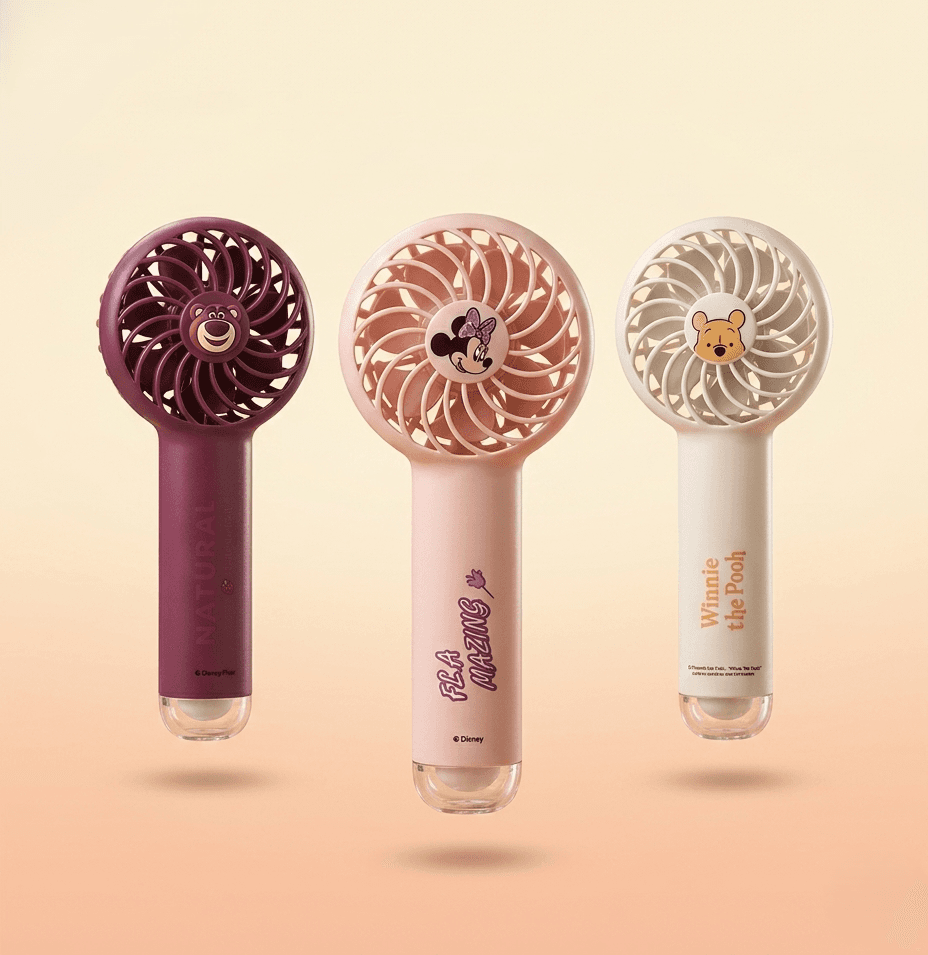
Handheld fans are small. A typical one is 4 to 6 inches long and fits in a backpack pocket, a purse, or even a large pants pocket. But you have to pull it out, unfold or extend it, turn it on, and hold it up. That is fine if you are standing in one place. It is annoying if you are walking, carrying a grocery bag, or pushing a stroller. You need a free hand.
Neck fans are hands free. You put it around your neck and you forget it until you notice the breeze. That is ideal for walking, biking, gardening, cooking, or doing anything with your hands. The problem is that they are bulkier. A neck fan is about 6 to 8 inches wide and hangs on your collarbone. It does not fit in a normal pocket. You have to wear it or carry it in a bag. And it is heavy. 8 to 12 ounces may not sound like much, but after an hour your neck muscles are working to hold the thing up. Some people get sore.
If you are someone who switches between hot and air conditioned spaces all day, handheld is better because you can stash it instantly. If you are outside for hours at a time and need both hands, neck fan is better.
Noise Levels That Actually Matter
Noise is a dealbreaker for a lot of people. Handheld fans are generally louder because the blades are larger and spin faster to produce that strong airflow. A typical handheld fan on high is 50 to 65 decibels. That is loud enough to be heard across a quiet room. You can use it outside without bothering anyone. But in a library, on a quiet train, or in an office cubicle, people will look at you.
Neck fans are quieter by design. The blades are smaller and spread apart. Most neck fans on medium are 35 to 45 decibels. That is about the level of soft conversation. You can wear one in a meeting without being disruptive. However, the pitch is higher. The motor whine is more noticeable than the fan noise itself. For some people that high pitch is more annoying than a deeper whoosh.
If you work in a quiet environment and need fan noise to be below conversational volume, neck fan is the better choice. If you only use the fan outdoors or in noisy settings, handheld's noise does not matter.
When Each One Fails Completely
Honesty means talking about the situations where each fan is useless.
Handheld fan fails when you do not have a free hand. Try holding a phone, a coffee, a bag, and a toddler hand while also holding a fan to your face. It does not work. Handheld fan also fails in direct sunlight. The airflow feels warm because the air itself is hot. A fan only cools by evaporating sweat, not by making the air colder. In dry desert heat, it works fine. In humid muggy heat, the sweat does not evaporate well, so the fan just blows hot air on your face. Neck fan has the same problem, but it feels slightly less miserable because the breeze is on more skin area.
Neck fan fails when you need a real blast. If you just finished a run and your entire body is overheated, a gentle neck breeze will not cut it. You want a strong handheld fan that can hit your chest and back. Neck fan also fails when you wear a hat. The upward airflow hits the brim of a baseball cap and gets redirected away from your face. You end up feeling nothing. And as mentioned, long hair is a constant enemy.
Quick Comparison Table
| Feature | Handheld Fan | Neck Fan |
|---|---|---|
| Battery life (high setting) | 1 to 1.5 hours | 2 to 3 hours |
| Battery life (low setting) | 4 to 10 hours | 8 to 12 hours |
| Wind strength | Strong, concentrated | Weak, diffuse |
| Portability | Fits in pocket, but needs hand | Hands free, but bulky to carry |
| Noise | 50 to 65 dB on high | 35 to 45 dB on medium |
| Hair tangling | Minimal risk | Common with long hair |
| Best use case | Short waits, direct cooling | Long wear, hands free activities |
| Worst use case | Multitasking, humid heat | Intense heat, hat wearers, long hair |
Which One Should You Buy?
The honest answer is: it depends on your day.
If you commute by subway or bus and spend most of your cooling time standing still for less than 20 minutes at a stretch, a handheld fan is the better buy. It is cheaper, simpler, and gives you that satisfying blast when you need it. You can get a solid mini handheld fan like the one featured on DearBuys for under $20. It fits in your bag, works well for quick relief, and you can give it to a friend if they need it.
If you work outdoors, walk long distances, or have a job where your hands are occupied, the neck fan is worth the tradeoff in weaker wind and neck weight. Just make sure you have short hair or are willing to keep it tied up tightly.
And if you can afford both, get both. Use the handheld for short bursts when you want real power. Use the neck fan for long stretches when you want to stay cool without thinking about it. That is the real answer, and it is the one most people end up with after trying both.
A fan in the hand is nice. A fan on the neck is convenient. Know the failure points, and pick the one that fails least often for your life.