A portable fan vs AC cost comparison starts with one number: watts. A typical portable fan draws somewhere between 5 and 50 watts, while a window or split air conditioner pulls 900 to 3,500 watts depending on size. Run the fan for eight hours and you might spend a few cents. Run the AC for eight hours and you are looking at a dollar or more per day in most US markets. That gap is real, but it is not the whole story, because a fan does not actually lower the temperature of a room.
The honest answer is that fans are dramatically cheaper to run but only work under certain conditions. AC costs more because it does something a fan cannot: it removes heat and humidity from the air. Whether the savings are worth it depends on your climate, your room, and how you sleep. Here is how to think through it without guessing.
How much does it actually cost to run a portable fan vs an AC?
Advertisement
Electricity is priced in kilowatt-hours, which is 1,000 watts running for one hour. Your bill depends on your local rate, which in the US ranges roughly from 10 to 30 cents per kWh depending on state, and in the UK and Canada sits in a similar band once you convert.
A box fan or pedestal fan on medium speed typically draws 40 to 60 watts. A small desk fan draws 10 to 25 watts. A rechargeable handheld fan draws under 10 watts while charging and almost nothing while running on battery. An air conditioner is a different category entirely:
- Small window AC (5,000 BTU): about 450 to 550 watts
- Mid-size window AC (8,000 BTU): about 700 to 900 watts
- Portable floor AC (10,000 BTU): about 1,000 to 1,200 watts
- Central air or a large split system: 3,000 watts and up
Do the math on a 50-watt fan at 15 cents per kWh for eight hours: 0.4 kWh, or about 6 cents. Do the same for an 800-watt window AC: 6.4 kWh, or roughly 96 cents. Over a 90-day summer, that is under $6 for the fan versus around $86 for the AC, assuming you run it every night. In hotter states with higher rates, the AC number climbs past $150.
That is the cost side. The comfort side is where people get surprised.
Does a fan actually cool a room, or just move air around?
A fan does not lower the air temperature. It cools you, not the room. Moving air accelerates sweat evaporation on your skin, which is why you feel cooler even though the thermometer has not budged. The practical limit is around 90 to 95 degrees Fahrenheit with reasonable humidity. Above that, or in heavy humidity, a fan starts pushing warm, damp air around and you stop getting relief.
This matters for your wallet because people buy a fan expecting AC-like results, then run the AC anyway. If you live somewhere with dry summers and overnight lows in the 70s, a fan plus an open window at night can genuinely replace AC for sleeping. If you live in a humid climate where it stays 80 degrees at 2am, a fan alone will not cut it, and you will end up paying for both.
The other thing fans do well: they let you raise the AC thermostat. The US Department of Energy recommends setting your thermostat about 7 to 10 degrees higher when you are away and adjusting for comfort when home. A ceiling fan or floor fan in the room you are actually sitting in can make a 78-degree setting feel like 74. That is a real saving of roughly 3 to 5 percent per degree over eight hours, which adds up to 15 to 30 percent off your cooling bill without giving up the AC entirely.
When does a portable fan win on cost and comfort?

A fan wins outright in these situations:
- You are cooling one person, not a room. A desk fan pointed at your chair uses a fraction of the power of cooling 300 square feet.
- Overnight temperatures drop below about 75 degrees. Open a window, put a fan in it, and skip the AC entirely.
- You are in a dry climate. Evaporative cooling works with you, not against you.
- You rent and cannot install a window unit, or your building restricts them.
- You need cooling for short bursts, like a home office during the day, not a whole-house system.
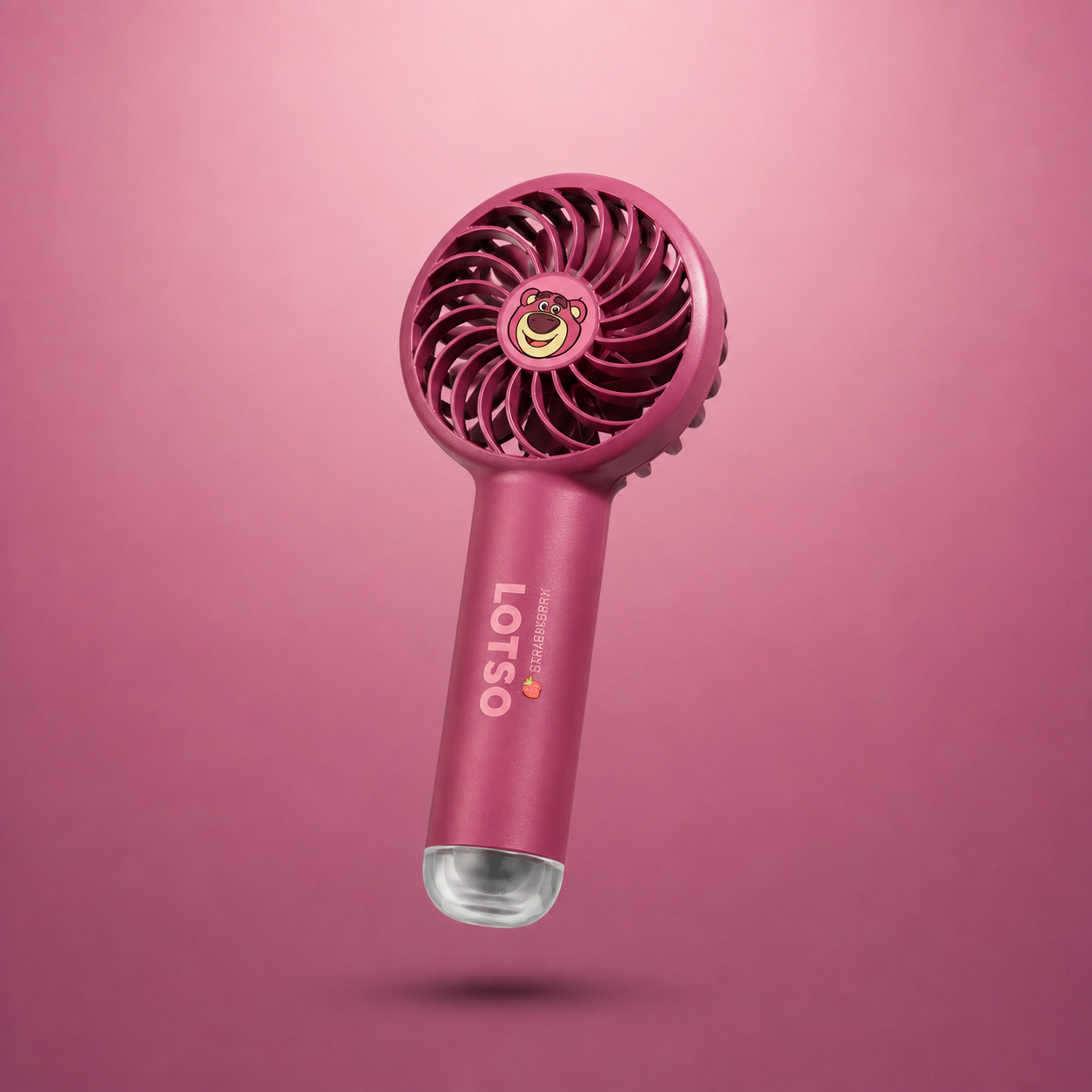
Handheld and mini fans are a subcategory worth calling out. They run on small rechargeable batteries, usually 1,200 to 4,000mAh, and last anywhere from 3 to 10 hours on low depending on the model. The Disney Mini Handheld Fans fit this slot: cheap to buy, negligible to run, and useful for a commute, a desk, or a stroller. They will not cool a bedroom. They will keep you comfortable in a queue or on public transport, which is a different job.
When does AC justify the higher bill?
AC wins when the heat is genuinely dangerous or when humidity is the problem. An air conditioner removes moisture as it cools, and that is why a 78-degree AC room feels better than a 78-degree fan room in July. Fans cannot dehumidify.
AC also wins if you have infants, elderly family members, or anyone with heat-sensitive health conditions. Heat exhaustion is not a budget problem you want to solve by toughing it out. The CDC treats indoor heat above roughly 90 degrees as a real risk for vulnerable people, and no electricity saving is worth a hospital visit.
And AC wins on sleep if you are in a hot, humid city. Poor sleep costs you productivity and mood, which has its own price. If you are waking up at 3am sweating, the fan is not doing its job and you should stop pretending it is.
The middle path: run both, but run them smart
You do not have to pick a side. The cheapest setup for most people is a small AC or heat pump in the bedroom only, set to 76 to 78 degrees, plus a fan in whatever room you are actually in during the day. Close doors. Cool the room you are in, not the house.
A few practical moves that cut cost without cutting comfort:
- Set the AC 7 to 10 degrees higher when you leave and use a programmable thermostat. Do not leave it blasting an empty apartment.
- Use a fan in the room you occupy so you can raise the thermostat a few degrees and still feel fine.
- Shade windows during the day. A west-facing window in the afternoon can add several degrees to a room and push your AC harder.
- Service the AC filter monthly in summer. A clogged filter makes the unit work longer for the same cooling.
- For personal cooling on the move, a rechargeable mini fan costs pennies a month to run and saves you from cranking the car AC or sitting in a hot office.
Quick comparison
| Factor | Portable fan | Air conditioner |
|---|---|---|
| Typical power draw | 10 to 60 watts | 450 to 3,500 watts |
| Rough cost per 8-hour night (at 15c/kWh) | 2 to 7 cents | 55 cents to $4 |
| Lowers room temperature | No | Yes |
| Removes humidity | No | Yes |
| Works above 90F | Limited | Yes |
| Upfront cost | $15 to $80 | $150 to $2,000+ |
| Best use | One person, dry heat, overnight | Whole room, humid heat, vulnerable people |
What to actually do
If your summer nights drop below the mid-70s and the air is not soupy, a fan plus an open window will save you real money and you should try it for a week before assuming you need AC. If you are in humid heat, or you have kids or older family in the house, budget for AC and use a fan to raise the thermostat a few degrees. The savings from that one trick alone often cover the cost of the fan in a single season. Buy the fan first. It is the cheapest experiment you will run all year.