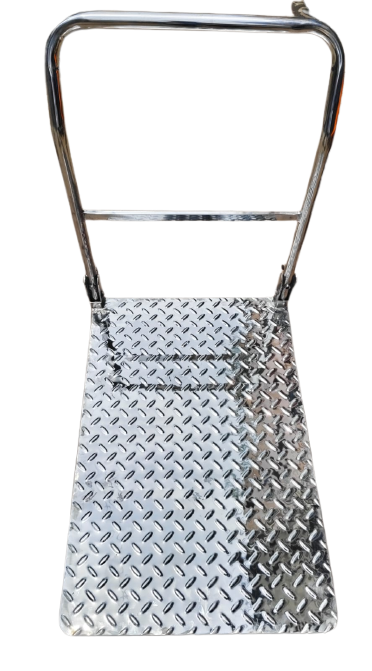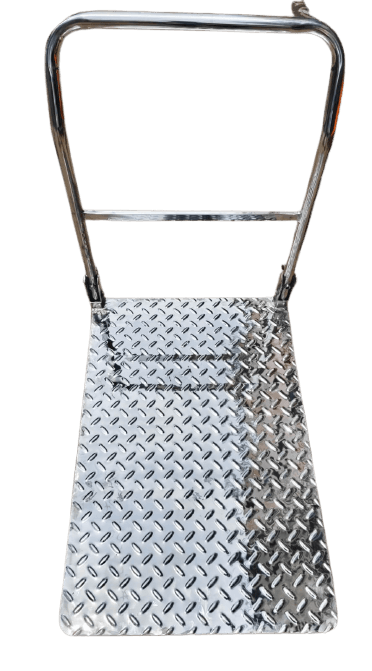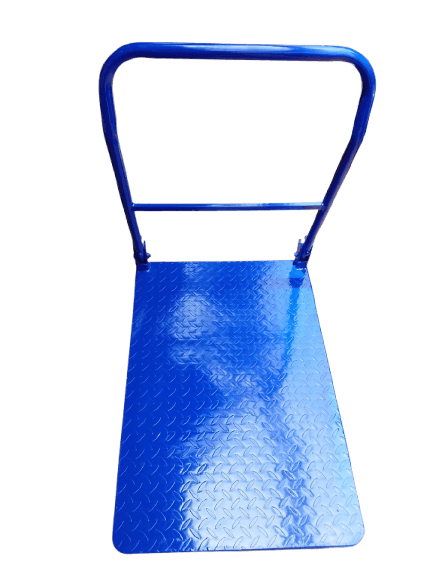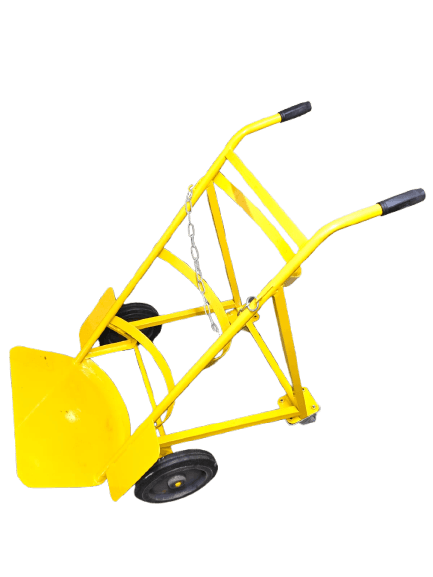
If you are moving sacks of rice, paint drums, or cement bags and you cannot decide between a platform trolley, a hand trolley, and a wheelbarrow, the short answer is this: a platform trolley in Bangladesh is the only one of the three that lets one person move a tall, unstable stack on a flat surface without balancing it. A hand trolley is for tall, narrow loads you can tilt and roll. A wheelbarrow is for loose, wet, or granular material you need to dump. Pick by the shape of your load and the surface you are crossing, not by which one looks strongest in the shop.
I have used all three on warehouse floors, in a tin-shed godown, and on a mud driveway that turns to slush in Bhadro. Here is what actually matters.
What can each one actually carry in real use?
Advertisement
Manufacturer ratings are optimistic. Real capacity depends on wheel diameter, floor quality, and how far you are pushing.
| Platform Trolley | Hand Trolley (Sack Barrow) | Wheelbarrow | |
|---|---|---|---|
| Typical real load | 150 to 300 kg | 100 to 200 kg | 60 to 100 kg |
| Load shape | Flat, stacked, boxed | Tall, narrow, tilted | Loose or wet, heaped |
| Wheel setup | 4 wheels, swivel front pair | 2 wheels, fixed | 1 wheel, single pivot |
| Floor damage | Low, load spread over 4 points | Medium, hard wheels dig in | High on soft ground, low on concrete |
| Turning space needed | Wide, roughly 1.5 m to turn | Narrow, about 1 m | Very narrow |
| Stability | High, will not tip on flat ground | Low, you are the balance | Medium, tips if overloaded |
| Best surface | Smooth concrete, tile, ramp | Flat concrete, short distances | Mud, sand, gravel, uneven ground |
| Price range (BD) | Higher, 4 wheels plus deck | Mid | Lowest |
Notice the wheel count. That single number decides almost everything. Four wheels mean the trolley carries the load and you only steer. One wheel means you carry part of the load in your wrists and shoulders.
Platform trolley vs hand trolley: which one for a warehouse?
If your floor is smooth concrete and your goods arrive in cartons, drums, or stacked sacks, the platform trolley wins and it is not close. You load it once, push it, and your back does nothing.
The tradeoff is space. A platform trolley needs a clear turning circle, and in a cramped godown aisle packed with stock, you will not have one. You will end up reversing out the way you came, which is slow.
A hand trolley is the better pick when your loads are tall and narrow: a fridge, a stack of five cartons, a gas cylinder, a water filter unit. You tip it back, the two wheels take the weight, and you roll. It fits down aisles a platform trolley cannot enter.
The catch with a hand trolley is that you are part of the machine. On a long push, your arm and lower back take the strain. On a wet floor, the hard wheels can slip sideways and the whole stack goes over. I have seen a loaded hand trolley go down on a just-mopped floor and it is not a cheap accident.
One more thing people miss: hand trolley wheels are usually solid and unforgiving. Run one over a tiled showroom floor for a month and you will see the scuff marks.
When does a wheelbarrow beat both?

A wheelbarrow is not a smaller version of the other two. It is a different tool.
Use it for anything loose or wet: sand, gravel, wet cement mix, soil, construction debris, fish, or agricultural produce. The single front wheel lets it go places the others cannot, and the open tray lets you tip and dump without unloading by hand.
Where it loses is capacity and stability. A 60 to 100 kg real load is normal. Push past that on uneven ground and the single wheel digs in and the tray tips. On a smooth concrete floor, a wheelbarrow is honestly the worst of the three: unstable, slow, and it forces you to lift the handles constantly.
If your job is moving 20 sacks of cement from a truck to a third-floor room, a wheelbarrow is the wrong tool at every stage.
Which wheel type should you look for?
This is where cheap trolleys fail first, and it is worth understanding before you pay.
- Solid rubber or PU wheels. Long life, no punctures, but hard. They transmit every bump to the load and they mark soft flooring. Good for rough concrete and outdoor use.
- Pneumatic (air) wheels. Smooth over cracks and uneven ground, quiet, kinder to the load. But they puncture, and in a Bangladesh summer the rubber perishes faster than you expect. You will be pumping them.
- Nylon or polyurethane casters. The standard for indoor platform trolleys. Smooth, quiet, non-marking, and they roll easily on tile. They hate grit and gravel.
- Cast iron wheels. Almost indestructible on concrete, brutal on any finished floor, and loud.
For a warehouse with a smooth floor and heavy loads, nylon or PU casters on a platform trolley are the practical choice. For an outdoor yard with broken concrete, go pneumatic and accept the maintenance.
Check the swivel on the front wheels before buying. A stiff swivel makes a loaded trolley fight you on every turn, and no amount of strength fixes bad bearings.
How much should you expect to pay in Bangladesh?
Prices move with the dollar rate and with the grade of wheel you choose, so treat any figure as a range rather than a fixed number.
A basic wheelbarrow with a steel tray sits at the bottom of the market. A hand trolley with two solid wheels and a steel frame sits in the middle. A platform trolley with four casters and a proper deck sits at the top, because you are paying for four wheels, a larger frame, and a load rating that actually holds.
The gap between a cheap platform trolley and a good one is usually in the casters and the deck thickness, not the frame. A thin deck flexes under a 200 kg load and eventually cracks at the corners. If you are moving heavy loads daily, spend on the wheels and the deck, not on paint.
Also budget for the surface. A trolley that is perfect on your warehouse floor may be useless on the broken footpath outside your shop. Many buyers in Dhaka end up with two tools for exactly this reason.
What most buyers get wrong
Three mistakes show up again and again.
Buying for the heaviest load instead of the average load. If 90 percent of your moves are 80 kg and only occasionally 250 kg, a heavy platform trolley is dead weight you push around all day. Match the tool to the daily job.
Ignoring the doorway. Measure your narrowest door, gate, or lift opening before you buy. A trolley that does not fit through is a very expensive shelf.
Forgetting the ramp. A loaded platform trolley on a steep ramp is genuinely dangerous. Four wheels do not help you brake. If you have a ramp, you need a trolley with a brake or you need a second person.
If you are setting up a shop or godown and want to see what a proper four-wheel platform trolley looks like next to the cheaper options, it helps to compare the deck and caster specs side by side rather than judging from a photo.
A quick way to decide
Ask yourself one question: what shape is my load?
Flat and stacked, smooth floor, heavy: platform trolley. Tall and narrow, tight aisles, short pushes: hand trolley. Loose, wet, or granular, rough ground, need to dump: wheelbarrow.
If you genuinely do all three, buy the platform trolley and the wheelbarrow first. Those two cover the widest range of real jobs, and a hand trolley is the one you can borrow for a day when you need it.